





















































Pashinyan highlights education and investment as keys to public sector innovation
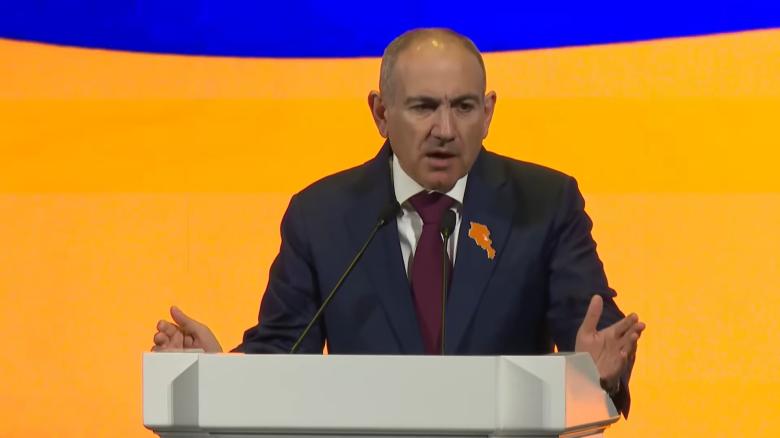
Prime Minister Nikol Pashinyan, in his speech at the Public Sector Innovation Forum III, emphasized the critical link between public sector performance, innovation, and the overall quality of life for Armenian citizens. “The quality of work in the public administration sector directly translates into the quality of life of the public. I believe, however, that this connection is not always recognized or understood everywhere. To make the lives of our citizens better, we need to improve the quality of governance in the public sector. And to improve governance, there is one key tool: additional investments in this sector.
In general, our thinking in many areas tends to be extra-systemic and extra-governmental, and we continue to believe that it is possible to avoid investment and still achieve good results relying, for example, on enthusiasm, emotion, dedication, and the like. At the same time, the role of enthusiasm, emotion, and dedication should never be underestimated,” the Prime Minister said, adding, “If there is no infrastructure to transform enthusiasm and emotion into value, then enthusiasm and emotion alone cannot have a significant impact.”
According to the Prime Minister, there is another challenge in improving the public sector in the current reality, because, at least on a subconscious and emotional level, the public sector is somewhat demonized. “This is connected to our historical experience. Our several-hundred-year history shows that we have dealt with a public sector that is oppressive, destructive, obstructive, and inhibiting. This has been the nature of our experience over the last 500 years, with some exceptions. And this perception continues to persist in our reality. The truth, however, is that the public sector constitutes the rails on which the train of our public life runs. We can make the greatest possible investments in the train itself gold-plating its seats and carriages but if proper investments are not made in the rails, the train either will not move at all or will frequently be at risk of accidents, which, let’s admit, happens quite often in our reality.
It is crucial to recognize that no citizen of Armenia has or can have more influence over their personal well-being than the public administration sector has over that citizen’s well-being. Therefore, changing our public attitude toward public administration is one of our most important tasks. In Armenia, there is not a single family or individual who spends more on their personal well-being than the Armenian state spends on that same individual’s well-being. Every dram of tax paid by each citizen is returned to that citizen tenfold,” Prime Minister Nikol Pashinyan stated.
Addressing the topic of innovation in the public sector, the Prime Minister first explained what innovation means in his view. “What does innovation mean? Innovation is education, because without education, innovation is impossible. To create something new, you must first know something new, and to know something new, you need education. This is why, over at least the last 1.5 years, the policy of the Armenian government has focused on making significant investments in the public sector investments that introduce self-sustaining educational systems within public administration.
We are doing this so that education in the public sector becomes a motivation in itself, and through education, new motivation for work and innovation is created, along with new knowledge and understanding. Thanks to these investments and programs, thousands of civil servants today are engaging with their education. After work, they participate in educational programs to improve their qualifications, to raise the quality of their work and this is done primarily to improve the lives of citizens and residents of Armenia,” Pashinyan said.
He added that any unresolved problem is a consequence of past underinvestment in public administration. “Today, there are many skilled and knowledgeable professionals in public administration, but I also want to say that knowledge alone cannot produce results. Knowledge must be placed in the right position and within the right system.
One example that impressed me most is the U.S. Apollo program mission to the Moon, which required the work of more than 400,000 scientists. This means that if that country had only 250,000 scientists instead of 400,000, this monumental project simply would not have happened. Of course, in our thousand-year history, we have never planned and, unfortunately, are still not planning to fly to the Moon, and there is only one reason for that: the absence of those 400,000 scientists and professionals. Because if those 400,000 scientists and professionals existed, could anyone explain why we should have given up on going to the Moon? Forgive the rough example, but there is a saying: ‘The fox’s nose cannot reach the grapes, so it says they are sour.’ Flying to the Moon is like those grapes for us it is indeed far off, because spring has just begun and there is still much time before the fruit is ripe,” Pashinyan concluded.
 Cross-stone dedicated to Armenian Genocide victims installed in Saint-Chamond, France
 Armenian welfare ministry seeks to extend pension cashback program
 Armenian government reiterates commitment to prompt signing of peace agreement with
 United States donates $1.4 million in equipment to strengthen Armenia’s border security