

















Participation of Deputy Foreign Minister of Armenia in the panel discussion “The EU as a Strategic Partner: Perspectives from Eastern Europe, South Caucasus and Central Asia”
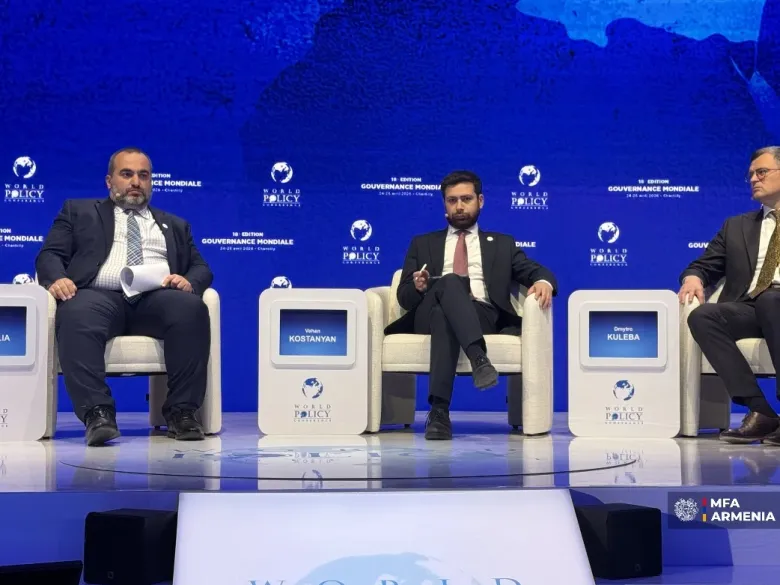
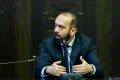
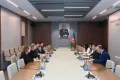
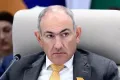
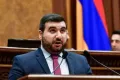
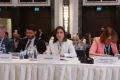
Within the framework of the World Policy Conference Deputy Minister of Foreign Affairs of the Republic of Armenia Vahan Kostanyan participated in the panel discussion entitled “The EU as a Strategic Partner: Perspectives from Eastern Europe, South Caucasus and Central Asia.”
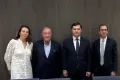
Other panelists included Lasha Darsalia, Deputy Minister of Foreign Affairs of Georgia; Dmytro Kuleba, Former Minister of Foreign Affairs of Ukraine; Roman Vassilenko, Ambassador of Kazakhstan to the EU, NATO, Belgium and Luxembourg.
Moderator: Mr. Kostanyan, thank you very much for being with us again. From your viewpoint, how do you see or foresee the future of the European Union, and is that future from your viewpoint important? And in what sense? What are your own interests in that future? And that is, when I ask about vision, I mean something that might displease themselves, that might be unpleasant for themselves. You can make predictions that you don't like for yourself, but if you are realistic, you have to make those predictions or to formulate them.
But at the same time, to be positive in the sense of making some remarks, recommendations on why is the interaction between the EU and your region or country important, and how could we better work between the European Union and your country or region?
Vahan Kostanyan. Thank you very much, dear Thierry. This is an absolute privilege to be back to the World Policy Conference (WPC).
Going back, when we started the panel, I was thinking what the situation in the world two years ago generally was. Today many things have changed. Saying this, I should mention that probably we are living in unconventional times. We were living in unconventional times two years ago as well, but today it's even more severe than two years ago, which means that conventional wisdom is not always working, or it's a single case where conventional wisdom can work. So now we really need unconventional solutions and steps which need to be taken.
Allow me first to describe what the developments on the Armenia-EU track from the perspective of Armenia are that we had during the last two years. Probably one of the most unconventional benchmarks on Armenia’s EU aspirations track is the law, which was adopted by the Parliament of Armenia last year in March, to allow the launching of the EU accession process. This is a clear political demonstration where the government of Armenia and also the people of Armenia see themselves in the future.
Saying this, we are not naive to think that in 2028 or 2030 we'll be able to become an EU member state. But this is a political declaration, which is the direction that we are working towards. With this, we set up a new ambitious agenda for reforms to be able to match the European standards. This reform agenda itself, we believe, is a very important exercise for us internally and domestically, which we are going through, starting from the visa liberalization dialogue that we have with the European Union. Currently we are the only country in the world with whom the EU has Visa Liberalisation Dialogue negotiations.
We are trying to see what the opportunities of enlarging the portfolio of cooperation on sectorial different tracks are. In fact, the document, which was adopted last December between Armenia and the EU – the Strategic Agenda of the Armenia-EU partnership – sets a good framework and a roadmap for the sectorial and gradual integration for Armenia to the European Union, for the first time having very important components on security, on economy, which was not the case when we are looking back to the CEPA agreement from 2017.
So having this said, probably I should mention that the EU became a real strategic partner for us. As our European colleagues like to say, Armenia-EU relations are closer than ever. But for us, this is not the limit, and we clearly see the next milestones which need to be achieved. With this regard, also to mention that we are going to have the Armenia-EU first summit hosted in Yerevan on May 5th, right after the European Political Community Summit, which we also have the privilege to host in Yerevan.
So things are moving quite fast. Unfortunately, European bureaucracy is not sometimes catching up with the speed of geopolitical developments in the region.
Moderator. You are a very good diplomat, in the way you are stating things.
Vahan Kostanyan. Yesterday with Lasha Darsalia, we were speaking about, Lasha made a point on different issues saying that sometimes we need to hurry slowly. But if we are speaking about strategic players, even with hurrying slowly, you should make sure that you are not late, and this is probably the biggest challenge today for the European Union. Sometimes we hurry slowly, but make sure that they or we together are not late.
Probably another comment on the European future and the Eastern neighborhood։ I guess given the time that we are living in and the agenda that the EU has with the different regions, the definition of the European neighborhood itself should also be redefined. A couple of years ago, when the Eastern Partnership, for example, was being born, the South Caucasus was the line where the European neighborhood was ending. Today, definitely the European neighborhood, at least from my perspective, cannot be strategic without Central Asia as well, and here, the South Caucasus and the three countries of the South Caucasus play a very important strategic role to connect Central Asia with the European Union. We see that there are different tendencies of this partnership growing.
Moderator. Thank you very much. It's very precise. In the medium to long term, these connections will most probably be organized and come into reality. Meanwhile, you have some other problems to solve in your environment. Azerbaijan is still there, and you have agreed to support the TRIPP project – looking at you, maybe you will correct my statement – which is supposed to allow Azerbaijan and Nakhchivan to connect. This certainly is a crucial point in the near to middle term. Can you comment a little bit about that and more generally, your relations with Azerbaijan?
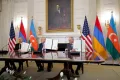
Vahan Kostanyan. Yes, thank you very much. To start, probably “supporting the TRIPP project” is not the precise definition of the agreements made in Washington, because, first, TRIPP is a project that Armenia has full ownership of, and second, we are ourselves much interested in the opening of communications in the region. And it's not only connecting the main part of Azerbaijan with Nakhchivan, it's a much bigger and strategic project to connect Central Asia to Europe and also to understand the commitment of having reciprocal benefits. It basically also means that the southern part of Armenia can connect to the northern part of Armenia using the Nakchivani rail. With the unblocking, which will take place, we will be able to connect not only the East to the West, but also the Gulf to the Black Sea, which is a huge game changer for the whole region.
We are much interested in implementing the project. There are active talks with the American colleagues on how we are going to establish the Armenian-American joint venture in Armenia․ We have already started not only the feasibility study, but also the opening of communication in the region itself, because after August 8, we have the precedent, for example, of importing grain from Kazakhstan using Azerbaijani and Georgian rails. This is a very unique example of how regional cooperation can work, and how creating additional interdependencies in the region can build more stability and peace there.
Coming to Armenia and Azerbaijan, both leaders of two countries numerously mentioned after August 8 that peace is already established between Armenia and Azerbaijan, and the processes that we have now, we like to call “peace institutionalization”, taking further steps to build economic ties between our two countries. We have already started direct bilateral trade, importing gasoline from Azerbaijan, and – hopefully in the near future – we have already identified what we shall be exporting from Armenia to Azerbaijan. At the same time we are working on people-to-people contacts: civil society representatives are meeting. What is important, we are meeting not only in foreign countries, but also in Armenia and Azerbaijan. We also have a very important format, which was established with our Georgian colleagues of trilateral consultations between the Ministries of Foreign Affairs, where me and my Georgian colleague Lasha are personally involved as well.
And here also we see a very big perspective of the regional cooperation not only between our three states – Armenia, Georgia and Azerbaijan – but also with the wider neighbors of ours.
Moderator. Thank you very much.
 Cross-stone dedicated to Armenian Genocide victims installed in Saint-Chamond, France
 Armenian welfare ministry seeks to extend pension cashback program
 Armenian government reiterates commitment to prompt signing of peace agreement with
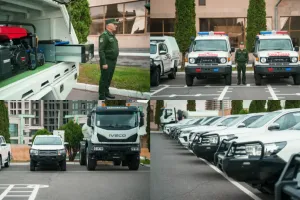 United States donates $1.4 million in equipment to strengthen Armenia’s border security